
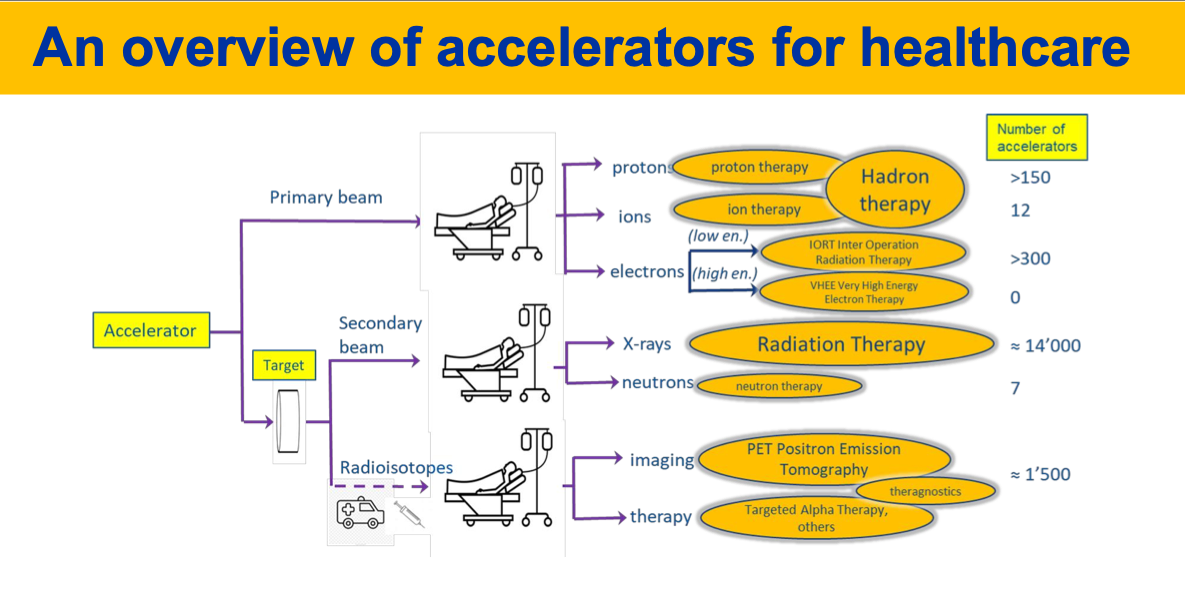
What is not widely known is that, of the almost 47’000 particle accelerators in operation around the world, only 6% are destined for research (0.5% for particle physics). The remaining 94% of accelerators worldwide are built for medical and industrial applications.
We are surrounded by technologies that require accelerators. Semiconductor technology requires accelerators to deposit ions in them. Sterilisation of materials without chemicals or cross-linking of polymers is also possible using electron irradiation. We use electron beam technology to treat wastewater plants.
These sophisticated machines are transforming our lives and, as of today, they are becoming indispensable weapons against cancer, delivering precise beams that target tumours while sparing healthy tissue.
The history of accelerators for medical applications is not very long, but it has already changed people’s lives, and ongoing research is very promising. For this reason, we’ve interviewed Maurizio Vretenar, a leading physicist at CERN, coordinator of the EuCARD2, ARIES, and IFAST European Projects for support to particle accelerator R&D and innovation, and a member of the program committee for the next CAS course on Medical Accelerators that will take place in June 2026 in Latvia. He will give us an insider’s perspective on the history of medical accelerators and will explain why this course is so important for this field.
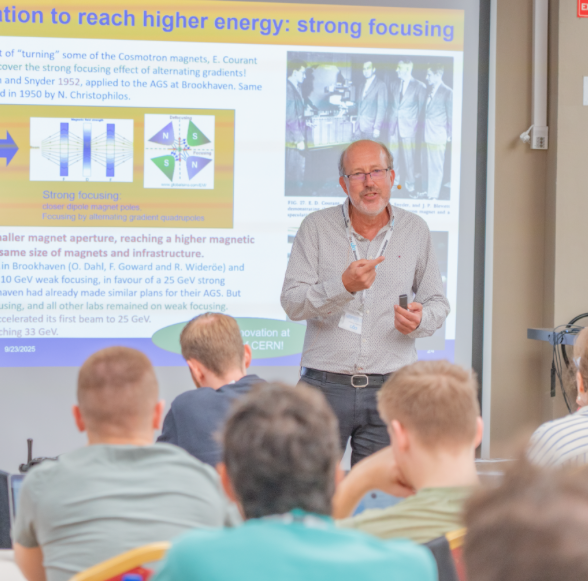
“The idea of treating cancer with particle beams is actually quite old," Vretenar explains. “The first experiments date back to the 1930s, with the concept of proton therapy emerging after WWII. However, translating this into clinical reality required building confidence in beam precision to treat cancer without harming patients.” Before the 1990s, proton therapy was primarily performed in physics laboratories. The 1990s marked a shift towards specialised, patient-centred systems that eventually integrated into hospitals. But why did it take that long to materialise this idea? “Medicine requires years of clinical trials to assess outcomes and results of new treatments. Only now we are seeing results that clearly demonstrate the real advantages of particle beam therapy”
Unlike conventional X-ray radiotherapy, which kills cancer cells but inflicts widespread damage to healthy tissues, particle beams concentrate energy precisely at the tumour site. Vretenar emphasises the unique advantages of this technology. “The real advantage is sparing healthy tissues—improving quality of life more than just reducing mortality,” he notes. "In the past, saving lives was the main goal. Now it’s not enough—people want quality of life too.”
Nowadays, investment in R&D for these technologies faces formidable challenges. Dedicated resources are needed to develop affordable medical accelerators and democratise access to this medical tool. Scientific accelerators were designed for one-time use, optimised for specific experiments without regard for replication or cost. Medical applications demand the opposite: reliable, affordable systems where "cheaper and reliable matters more than top performance." Yet progress is slow—clinical trials take years for statistical validation, and new accelerator technologies require many years of development. CERN makes a significant effort to transfer its technologies for societal applications but prioritises fundamental research. To develop this field, additional external funding is needed, but it is challenging: “It is nice to be interdisciplinary because progress happens between fields, but financing is harder because you don’t fit into either category. Everyone tells you it is not their priority, go to the other side.”
Despite all of these challenges, advancements in medical accelerator technology are visible, and CERN’s track record illustrates both the promises and the hurdles along the way.
The PIMMS project in the late 1990s, funded after LEP construction to showcase societal impact, led to Italy’s CNAO and Austria’s MedAustron proton and carbon-ion centres, both of which are successfully treating patients. These facilities now expand ambitiously: CNAO will now add dedicated proton therapy, neutron therapies for brain tumours, helium beams, and for the future is even exploring radioisotope production.
Today, the future of CERN’s medical accelerator development is being defined. "We’re at a magic converging moment—demand is rising as technologies become applicable—but it takes long-term stable engagement and strong collaboration with partners outside CERN," Vretenar warns.
Our main goal is to reduce therapy costs by designing cheaper and smaller accelerators. This technology must spread globally, become standardised, and throughout artificial intelligence, we hope to make accelerators easier to operate and maintain.
These barriers highlight the imperative for interdisciplinary training and teams. “Progress happens at the boundary between physics, medicine, and biology," Vretenar asserts. “You need physicists understanding beam-tissue interactions, medical physicists grasping machines, and doctors comfortable with technology.” Although interdisciplinarity sparks innovation but complicates financing, there are solutions in the form of EU-supported projects encouraging interdisciplinarity and collaboration. Vretenar has coordinated the IFAST project that involved advanced lab-industry collaborations, and now plans to submit to a very competitive EU programme for innovative technology a €4 million bid for helium-ion therapy incorporating AI for simplified operation.
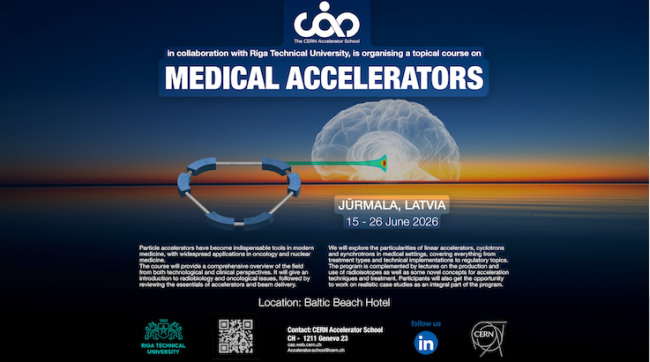
The CERN Accelerator School’s Medical Accelerators course, to be held in Riga this June 2026, directly addresses these gaps. Organised by CAS to bridge accelerator science and medical physics, it intentionally targets different profiles: early-career professionals from labs, universities, and accelerator manufacturers and operators seeking knowledge of medical applications, and hospital medical physicists interested in how accelerators operate.
This course will not present accelerator design in detail, leaving the subject for the general CAS schools. Instead, the course will focus on how accelerators work, key parameters, and critical aspects for those designing/operating therapy centres—the goal: foster connections birthing next-generation machines while spreading interdisciplinary knowledge to the global accelerator community.
This training is timely amid global momentum. “We are at a magic moment for particle therapy* U.S. carbon-ion interest is growing, and a new multiple-ion facility is in construction in Europe. New clinical evidence is showing the advantages of proton therapy, and new centres are being built worldwide: Spain is driving a strong initiative, and new centres are planned in Argentina, Brazil and Middle Eastern countries.
Our main goal is to reduce therapy costs by designing cheaper and smaller accelerators. However, the accelerator is only a small part of the system. It must be integrated in a complex medical facility, where protocols and personnel are driving the costs. This technology must spread globally, become standardised, and throughout artificial intelligence, we hope to make accelerators easier to operate and maintain. We must reduce not only construction costs but also operational costs to make this technology accessible to the largest population.”
The 2026 CAS course aims to equip the next generation with knowledge and vision for the future medical accelerators: standardised, intelligent machines spreading precision therapy worldwide, turning physics' greatest tools into humanity’s greatest hope against cancer.
With stable long-term programmes, interdisciplinary teams, and visionary training, a perfect accelerator isn’t a distant dream—it's our imminent reality.
*Vretenar pioneered lectures on linear accelerators for medical applications since 2011-2012, and since 2018 has been in charge of the Next Ion Medical Machine Study, a collaborative research programme based at CERN. The first topical course on accelerators for medical applications was in 2015. You can find the CAS proceedings here. We foresee the publication of new proceedings for this course. They will be found on the CAS website.